The situation
Verity Building Systems reached $180M in revenue by acquiring its way across a fragmented regional market — four add-ons in twenty-six months, most recently Fairmount and Crescent. Each acquisition arrived with its own sales process, its own quoting spreadsheet and its own idea of what a proposal looked like.
The sponsor, Halstead Capital Partners, had underwritten a buy-and-build thesis targeting $300M by FY2028. That thesis assumed the platform could integrate a salesforce. By early 2026 it demonstrably could not.
We closed Fairmount and Crescent inside eighteen months, so we are now sixty-two field reps across nine branches. Every branch sells a different way. Dana Whitlock, Chief Revenue Officer
The problem was documentation, not talent
The leadership team had already diagnosed the constraint correctly. What they had not solved was that none of it was written down. There was no buyer intelligence, no opportunity management guidance and no standards of excellence in any documented form. New reps learned by shadowing whoever was nearest.
That showed up in the proposals. A branch manager in one region would send a two-page quote; another would send a fifteen-page deck. Neither quantified anything. When the CFO asked why a deal had been discounted, the answer was in someone's memory.
A prior attempt had failed for a related reason. The company bought a sales training platform in 2025 and nobody used it, because branch managers never changed how they ran their one-on-ones. Tooling alone had already been tested and rejected by the organisation.
What changed
Verity deployed Groundwork across fourteen seats, configured against their own workstream library rather than a generic template. Three things did the work:
- Discovery became evidence. Every call is transcribed and mined across the eight extraction categories. Facts arrive pinned to the line where the client said them, so the proposal cites the buyer rather than the seller.
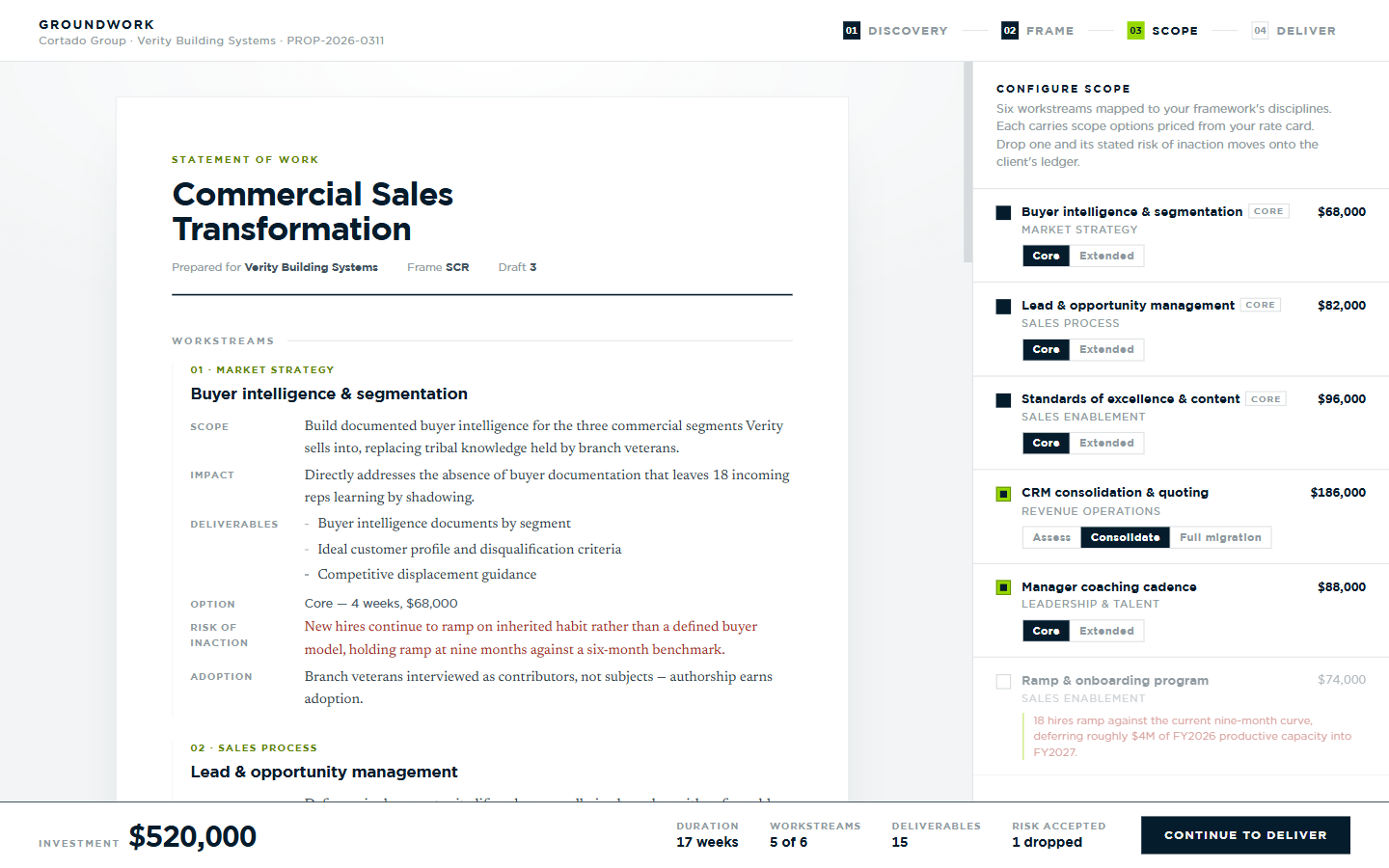
- One scope library, nine branches. Workstreams map to named GTM disciplines and carry fixed options. A branch manager configures a scope; they do not author a document.
- Risk of inaction on every item. When a client removes a workstream, the stated consequence moves to a descoped ledger they sign against.
The result
The proposal cycle went from twenty-four days to six, measured from discovery call to document sent. More consequentially, the documents stopped being arguments about effort and started being arguments about consequence.
The descoped ledger changed the negotiation more than anything else. Clients used to ask what we could take out. Now they read what happens if they do, and mostly they leave it in. Marcus Oyelaran, VP Sales
For Halstead, the reporting benefit arrived second and mattered more than expected. Because every proposal is structured the same way and every claim is sourced, scope and pricing are now comparable across nine branches — and will be comparable across the next add-on without a further integration project.